
The church has been spellbound by the leadership myth for the last twenty years. We’ve all come to believe that everything rises and falls on leadership. Consequently, most of the books that most of our pastors are reading – particularly in very large church settings – are about how to be a better leader.
That’s not entirely bad.
Pastors, for better or for worse, are leaders. And, one of the major setbacks of churches in the early 20th C was poor leadership. So, it’s probably fair to say that a certain amount of leadership development is required in order to pastor well.
Personally, I have read over 200 books on leadership. I have read almost all of the top-this or top-that books on all those top-lists. I have followed blogs and articles. Sometimes, I think I could teach more on leadership than I could on most of the books in the Bible.
And there’s the problem.
At key points, leadership philosophy and Biblical wisdom diverge…and most of us don’t know when that happens.
Take King Solomon, for example, who is almost universally held up as an example of biblical leadership. He was wise, by all accounts he ruled well, and he wrote much of the poetry in the First Testament.
But, I’m not convinced that he was as great a leader, nor as great a follower of YHWH as we’ve been lead to believe.
Consider this:
• Solomon weakened his dynasty to the degree that after his death the kingdom was split in two
• Solomon disobeyed God and made treaties and alliances with his former enemies
• Solomon disobeyed God and took his wife’s gods to be his own, leveling himself in apostasy
• Solomon neglected justice in favor of military expansion – something God had spoken strictly about before
Anyway, my point is not to defame Solomon, simply to point out that most of our material on the “Leadership Secrets of King Solomon” conveniently neglect his failures.
Just as most of our books on “Jesus, the Leader” focus on the concept of “Servant Leadership”, but ignore what servant leadership really means.
Servant leadership isn’t about teambuilding, consensus, profit sharing, or good human resources departments.
Servant leadership isn’t about listening before speaking, or seeking to understand before you beg to be understood, or beginning with the end in mind.
Servant leadership is about death.
Leadership is martyrdom. You lead to bear witness. You die to yourself, to your preferences, to your greed, and to your pride.
Why?
So that others can live.
So that others can be made whole, can be healthy, and can have fullness.
Solomon, for all his successes and exploits, was nobody’s servant. Good King Wenceslas, however, and Good King Jesus, additionally, were.
Isaiah prophesied that Jesus would heal the world, bringing salvation to all the nations on Earth. Jesus suffered for his mission to bring healing. He was murdered, illegally and unjustly, for being the Great Physician.
He died so we could live.
That is servant leadership.
Leadership is not rooted in position or privilege, it is rooted in pain. People will follow someone who is passionate to a flaw, who is devoted beyond good sense, and who is willing to be the first to bleed.
That’s the most attractive thing, to me, about Good King Wenceslas: he bled. He walked barefoot in the snow, he worked in the fields alongside his people, he forsook his sexual privileges, he emptied his own pockets, and he gave himself to his land.
That’s leadership.
And it has inspired no shortage of followership – Wenceslas has become a saint, has his own Christmas Carol, inspired Pope Pious to imitate his humility, and has a collection of hagiographies.
John 12.24
Unless a kernel of wheat falls to the ground and dies, it remains only a single seed. But if it dies, it produces many seeds.
Luke 9.24
Whoever wants to keep his life must lose it.
Wednesday, December 10, 2008


The Kingdom of God (in real life)
In the midst of remarkable suffering, ancient Israel anticipated a time when things would be different. Having been invaded (and enslaved) by the Assyrians, Babylonians, Persians, Greeks, Seleucids, and (finally…and worst) the Romans the Hebrew people were desperate for God to intervene on their behalf.
They had now finally seen their ancient error in asking for human rule (instead of remaining a nation governed simply by YHWH). They had lived through thousands of years of broken government: Saul, Rehoboam, Jeroboam, Omri, Ahab, Ahaziah, Pekah, Nebuchadnezzar, Cyrus, Alexander the Great, Seleucus, Antiochus, Herod, Ceasar.
They wanted something different. The image that best captured their expectation was “the kingdom of God.”
So what did that entail, practically, for them? And, concordantly, what does that entail, practically, for us?
Israel looked to a day when there would be “no king but God.”
• no allegiance to compete with God
• no security apart from God
The holy land, trampled and polluted by pagans, would be cleansed so that Israel could again live in communion with the Lord.
• reversing the curse of Sin and the sweat and toil associated with the Land
• healing the fruit of the land and of our labor
• redeeming workplace tension
• redeeming issues of worth and esteem for men based on their Work
• ensuring there would always be enough to sustain life, and that sustenance would be good
(non-toxic to the body, etc.)
God would return to the temple that he had abandoned and would once again dwell among his people (Malachi 3:1).
• there would be no separation between us and him
• we would be in his felt/experienced Presence every minute
• every place would be as the Temple – a liminal space where heaven and earth collide (…on
earth as it is in heaven…)
The nation would be liberated from its bondage to pagan oppressors, just as it had been delivered from Egypt and Babylon.
• we are freed from the bondage of our addictions, habits, evil desires, effects of sin, etc.
• the narratives of violence, control, dominance, consumerism, amnesia, no-belief,
hopelessness, despair and greed will be exhausted
The rule of Caesar in Rome and of his puppet kings and priests in Israel would be swept away, and the rule of God would set things right.
• authority and government will uphold justice in truth (not just in name)
• we will have confidence that our rulers/leaders serve YHWH and the people (in that order) as
suffering servants, rather than as despots, dictations, or power-hungry bureaucrats
The coming kingdom would mean liberation from foreign cultural dictates and an endorsement of Israel’s status as the elect people of God.
• our spiritual practices and preferences would not be watered down or compromised by the
state (or public opinion) in any way
• there will be no interference with worship (or healing [of the world, of others, etc…])
It would mean the reformation of the people in obedience and faithfulness toward God as he poured out his Spirit upon them and “circumcised their hearts” (Deuteronomy 30:6) so that they could obey the Torah.
• we will all be disciples and followers and servants, not merely cultural Christians who feel
entitled to the privileges of religious observation
• we would recognize that we are all on a spiritual journey
• we would all endeavor to continue shadowing God, becoming increasingly hospitable to the
Spirit
Jews of past generations who had remained faithful to God throughout Israel’s many years of exile and bondage would be raised from the dead to experience—together with the living remnant—the coming of God’s kingdom (Daniel 12:2).
• our elders in the faith will see the fruit of their labors in our lives and in the lives of the
persistent church
• they will know that their faithfulness has paid off in the lives of those they’ve lead, corrected,
discipled, and formed
• the kingdom will be built upon the extended faithfulness of the saints through God’s grace;
meaning that, to whatever degree is possible in this world, the kingdom will be realized
through God’s people living in God’s way for a LONG time (as opposed to ‘fits and starts’ of
holy living)
Until the kingdom should actually arrive, the faithful in Israel lived in hope: they prayed, studied the Scriptures, celebrated the festivals to keep hope alive, remained faithful to the Torah, and continued to be ready for military action.
• even though the kingdom has not yet been fully realized in this world, we should continue to
live as though it has
• our lives should be lived consistent with the kingdom, keeping kingdom values and
perspective, etc…
The Message of Jesus Christ – his primary pet topic – was that the kingdom was both here (now) and is on its way (will be here fully soon). Hopefully, the bullets above can help you to understand what he meant by that.
Tuesday, December 09, 2008


Monday, December 08, 2008
my wife is dead sexy (waldorf salad recipe)
i'm blest with an awesome wife...she makes the stepford wives look like a collection of rejected-hilary-clinton-imitators...and not because she's old-school or subservient, either
she's just plain awesome
fun. cool. smart. playful. mischievous. great mom. hot-as-*%*%
you get the idea.
anyway - from time to time she'll make my favorite recipe. she hates it, but out of her deep love for me, she'll make it and force me to fall in love all over again.
waldorf salad.
but not just any waldorf salad...oh no...traditional waldorf salad is crap...this is an ancient mcdonald family recipe dating back hundreds of years to the old country
(ok - that last part was a lie...it's just really, really good waldorf salad)
for your culinary enjoyment here is the recipe:
2 1/2 cups miniature marshmallows
2 cups green grapes, seedless
2 chopped red apples
1 peeled mandarin orange
1/2 cup chopped celery
1 cup walnuts
in a bowl combine
1 cup whipping cream, whipped
1/2 cup mayonnaise
1 TBSP sugar
mix all ingredients together...
...and pass out in the alaphylactic shock of pure bliss
(p.s. if you tell anyone i posted a recipe on my blog i'll never agree to pray for your sick grandmother again)
d
wow...big thanks
yesterday at the winds we received a special offering for our pastors as a christmas gift.
from carmel and i, i'd just like to say thanks to all of you who gave (and gave generously) to us and to our staff. it is very touching to receive such a tangible demonstration of your appreciation for our ministry.
you are too kind.
thanks, too, to all the staff at westwinds who (along with our heroic elders) have walked through fire with us. i think it's safe to say we've put our ghosts to rest, our past behind, and are looking forwards to increasingly wonder-filled days of serving jesus in a one-of-a-kind church.
everything we've won through together has come at a personal cost to you and your families. i am proud to serve with you.
again - thanks to everyone who has made this year at westwinds such a fantastically monumental year of advance.
d.
Sunday, December 07, 2008
A Russian church for a Saudi mosque?
This delightful story just came in thanks to getreligion.org: The Saudis have recently asked permission to build a mosque in Moscow, a city where there are only four mosques and 2 million Muslims. The Russians, however, are saying they want, in return, an Orthodox church in Saudi Arabia.
As we all know, the Saudis have a habit of constructing mosques in dozens of world capitals while forbidding houses of worship for any religion whatsoever outside its Wahabist brand of Islam. They've gotten some bad PR locally for some of the hate language in textbooks at the Saudi Academy in northern Virginia. Not only are hapless Christians terrorized and jailed for daring to hold private prayer services in Saudi Arabia, but God help them should they try to convert someone to their religion. And that's for a fellow People of the Book: One can only guess at what the treatment of Buddhists and Hindus must be like.
Wouldn't it be so ironic if the Russians were the first Christian body to win acceptance of the right to build a church in, say, Riyadh? (Some of the Russians are calling for a church in Mecca, but the chances of any other religion getting a foothold within walking distance of the world center of Islam is less than zero.) Of course we all know the Saudis aren't about ready to let Bibles or other religious literature, let alone a church, anywhere near their homeland, but all the same, it's amusing to see the Russians give the Saudis a taste of their own medicine.
Saturday, December 06, 2008
open source theology
the theology we need is like an OPEN SOURCE OS
open source OS (like linux or ubuntu) is a user-interface created by geeky guys in their bedrooms that will do everything you want on your computer for free. it will run every program (including making programs - for free - that typically cost upwards of $1000) and any problem you ever have can be solved by receiving free advice from other open source users.(they help because they are sooooo excited that yet one more person has discovered the wonder of an open OS.)
open source OS will do anything you need it to. it will run anything you need it to. it's harder to understand...waaay harder to use...but the rewards are infinite.
unpacking the metaphor: we need to be less concerned about making everything "fit" into one system of thinking and more concerned with being open enough to embrace the movement of god...even (or perhaps especially) when it's confusing, mysterious, or unexpected.
we need to read ALL of the bible in its original context in mind of its original audience...not just pieces of the bible that say things we like, or bits of the bible that seem (at first) like they were meant just for us and our friends.
we need to read the bible with our traditions, allowing scripture to edit those traditions when we discover that some of our favorite things actually have no basis in scripture.
above all? we need to realize that the WHOLE POINT of any OS (read "theology") is so that we can use the programs (read "gifts"and "fruits" of the spirit)...so we need to constantly be evaluating ourselves (and our OS/theology) on the basis of whether or not we're loving people better, serving god more wholly, and being more useful in god's mission to save the world.
and dangers? are there any big dangers to this open source theology? YES...absolutely. the biggest danger comes from anyone who latches onto an idea that is neither biblically substantive nor open to testing by other leaders and thinkers (i.e. their idea is complete crap but they refuse to acknowledge it...so they become a cult leader). without systemic accountability anyone can run with any idea regardless of how kooky it is...the only way to avoid this danger is to open ourselves to dialogue, attend to our critics, and lean on the creeds as pillars of our orthodox confidence.
but - even with this very dark danger in mind - the rewards for faithfully following jesus are worth the risk of turning into a weirdo.
it's better for us to uphold the values of studying the scripture and opening ourselves to a more robust and deep-feeling experience of god through prayer and the guidance of the spirit...than simply memorizing a bunch of retread theology done by the swiss and the germans five centuries ago (or the italians and the french one millenia ago).
contemporary examples of the good OS: rob bell, tom wright, peter rollins, michael frost & alan hirsch, len sweet
historical examples of the bad OS: david koresch, jim jones
wesleyan theology is like WINDOWS OS
wesleyan and lutheran theology are like windows.
there's a widerange of availability. the old OS versions often work better than the new ones. it becomes frustrating to upgrade all of the time, but the payoff is pretty good because there is always newer and newer software that works on virtually every computer.
however, the OS crashes all of the time, when you need the OS to solve a problem you've caused by overloading it.
to unpack the metaphor: there is great freedom in wesleyan churches...freedom to grow, to learn, to discover christ and the freedom that he brings
but there is also a great deal of confusion...people often feel like there is no "one truth" or that any reading of the scriptures counts as a valid interpretation. grace is often taken for granted and transformation typically ends right after a single sinner's prayer is prayer.
contemporary examples of the good: greg boyd, earl creps,
historical examples of the bad: dennis rader (infamous serial killer), leni riefenstahl (nazi propaganda filmmaker)
reformed theology is MAC OS
catholic and reformed theology are, in my mind, akin to MAC OS.
they are easy to use and quick to learn. the OS is intuitive and you always know where to get answers. they only work with their own software, however, and much of their energy goes towards advertising the flaws in other operating systems. plus, they prohibit you from doing anything other than exactly what they want you to do.
to unpack the metaphor: these theologies have got everything figured out. they sew up all complexity neatly and tidily. they leave no stone unturned.
or so they think
in actuality, there are a million little questions for which these theologies have no good answer...and you'll be damned straightaway is you start asking them. furthermore, if you ever find some of their "perfect" answers less than perfect, you'll be considered a heretic and promptly be subjected to church discipline.
when these theologies work, they work great - lives are transformed, people find faith in christ jesus, etc.
but when they don't work things fall apart fast - leading to violent and harsh beliefs, lack of love, and love of religion instead of the way of jesus.
contemporary examples of the good OS: pope john paul II, ronald rolheiser, mother theresa, ed setzer, john piper
historical examples of the bad OS: hitler, tsar nicholar II, sam bowens (founder of the KKK)
theology is an OS
because of some personal junk i've been thinking through lately (see my last 2 blog posts), i've come to think of all systematic theology as being an operating system.
an operating system allows you to access the programs installed on your computer.
in our little metaphor here, the operating system is our theology and the "programs" are the gifts of the spirit and the fruits of the spirit.
(remember...this is just a metaphor)
anyway, i think we forget that our theology is really just a way for us to better understand how god wants us to live and to whom we owe our allegiance.
god wants us to live self-sacrificially (kenotically...for you theology dorks)
and god wants our total and complete allegiance to him and his kingdom at the expense of everything else.
our theology SERVES THE PURPOSE of transforming us into people who shadow god in every moment.
if, then, our theology does not lead us into this kind of life it is useless and flawed (jesus said: you'll know a tree by its fruit...ergo, if your theology doesn't produce fruit that transforms you into a more loving, self-sacrificial, penitent follower of christ then your theology is broken).
ok...more later...
retraction...and frustration
i've removed my most recent post (formerly titled "pathetic") in which i said some pointed things about another pastor.
i was angry - having just finished reading 4 of his books in which he blasted other church leaders by name - and felt like i needed to steer our people (and many of my friends) away from his ministry and his influence.
anyway - carmel (my wife) told me i'd committed the same sins i was frustrated with this pastor for making by virtue of writing this angry blog post.
she was right.
so, i've removed the old post; but am feeling a little frustrated about how to interrupt the growing influence of this other pastor whose theology is good and clear (though narrow and strictly reformed) and whose preaching is exceptional (though angry and frequently slanderous).
i just don't want the people i love and am called to serve to think that right theology is somehow more important than right behavior, right relationship, or right missional activity. those four things go together (or at least they should) and when somone emphasizes 1 over the other 3 things get very much out-of-balance and can cause serious real-life damage.
historically, we have many, many examples of people whose theology was perfect but whose lives were almost the exact opposite of christ. everyone from the inquisitors to the crusaders and the nazis to the klu klux klan used pristine, biblical theology to justify dehumanizing other people, using violent rhetoric that erupted into violent action.
theology, then, is obviously not the only thing we need to consider while following jesus.
truth be told, though; most of the justification for acting like an ass comes from an overemphasies on pauline theology.
paul was brilliant, inspired by the holy spirit, and has taught us much about how to be the church.
but he's not the only author in the new testament for a reason.
his harshness (and that of james') must always be read alongside peter (who taught us to suffer well) and john (who taught us to love always) and jude (who warned us against teachers whose lives misrepresented christ jesus).
not to mention jesus' own words which - above anything else - taught us to love god and love one another self-sacrificially.
so - i'm frustrated...frustrated that many good and godly people who are becoming excited about theology for the first time may very well miss the forest for the trees.
they'll get their reformed (regurgitated) calvinist (calculus) doctrine perfect...
...but end up following the example of their teacher and becoming hateful, prejudicial, and unchristlike.
and that makes me sad.
Thursday, November 20, 2008
excerpt from my favorite sermon i've ever preached (on santa claus)
In effect, Santa is providing for us an example of what a Christian actually is. He’s demonstrating Christian spirituality as he brings gifts, as he spreads hope, as he delivers joy and as he demonstrates to the whole 21st Century world what it means to truly live a life of generosity. The things Santa does are themselves rooted in and motivated by his love for Jesus Christ. So, too, we ought to look at the person and work of Jesus Christ and be motivated to be like Santa.
Is that a bit of a stretch? It was for me too when I first began to think about it. Then I started going back again and again to the pages of the New Testament and reading through Santa Claus-colored glasses what we were being instructed to do by the Apostle Paul or what Jesus was instructing us to do. What kind of instructions do we see in the pages of the New Testament text?
I want to read from Ephesians, Chapter 4 in The Message translation. This is Paul writing to the persecuted Church in the region of Ephesus, which is the same region in which Santa Claus was born. Remember, Santa Claus read this letter; this was part of Santa’s Bible. These are the words that made Nicholas, St. Nicholas. These are the words that transformed a fishing boy into the most powerful and significant cultural icon in the last two millennia. He’s more famous than any theologian, pope, charitable person or movie star; everyone knows Santa.
Look at the words now that made Santa, Santa.
While I’m locked up here, a prisoner for the Master, I want you to get
out there and walk—better yet, run!—on the road God called you to
travel. I don’t want any of you sitting around on your hands. I don’t
want anyone strolling off, down some path that goes nowhere. And
mark that you do this with humility and discipline—not in fits and starts,
but steadily, pouring yourselves out for each other in acts of love, alert
at noticing differences and quick at mending fences.
You were all called to travel on the same road and in the same direction,
so stay together, both outwardly and inwardly. You have one Master, one
faith, one baptism, one God and Father of all, who rules over all, works
through all, and is present in all. Everything you are and think and do is
permeated with Oneness.
But that doesn’t mean you should all look and speak and act the same.
Out of the generosity of Christ, each of us is given his own gift.
He handed out gifts above and below, filled heaven with his gifts, filled
earth with his gifts.
We take our lead from Christ, who is the source of everything we do. He
keeps us in step with each other. His very breath and blood flow through
us, nourishing us so that we will grow up healthy in God, robust in love.
Think about what those words must have done to a simple, little boy who grew up surrounded by the courageous confidence of men and women who are willing to be put to death for their religious convictions. For Nicholas, as a boy, all of those heroes for him would have been people who looked almost the same. They would have been from the same kind of socio-economic class, gone from place to place preaching and praying for people to perform acts of healing and acts of proclamation.
But Nicholas does something totally different. He makes the mission of Christ his own. He changes the way he is going to express Christian spirituality. Instead of going and preaching, he goes and gives gifts. He doesn’t go and give gifts publicly, he does it at night, in secret, so no one will ever look to him and talk about how great or wonderful he is. He just wants to give because he’s motivated by generosity.
It’s hard for us sometimes to separate the real St. Nicholas from the Santa Claus on the Christmas card, or the Santa Claus on the Christmas ornament, but we must – we must remember that Santa Claus is real. Santa Claus is motivated by affection for Jesus Christ to do things that will never benefit him or make his life better, but will only help to make our lives more full of joy. He teaches us what it means to believe. If you’ve got kids you see what Santa Claus does; you see how he awakens hope. He changes the perceptions of people and families from brokenness to joy, from despair to hope, from poverty to prosperity.
These things are Christ things. These are Jesus things, the things Jesus taught the apostles, the things they wrote about in the Bible. For us, this year, as counterintuitive as it might seem to talk about Santa Claus at Christmas in a church, it changes Santa from just a pop culture symbol and puts him right in the middle of the Christian Christmas story.
It teaches us Santa Claus isn’t a provider, but an example. We ought to be like him as he endeavors to be like Jesus Christ.
It’s our great ambition and hope for us all this year (and every year to come) that as you look at Santa Claus in the mall or in the cards that you recognize there is in St. Nicholas a power to change the world. That authority, that motivation, is placed there by God in him and it’s ready and able to be placed in us as well.
is porn psychologically combatible?
had lunch with my friend greg, a mental health professional, today. he and i have been talking about the incredible cultural saturation of pornography - an epidemic, in his words - and about the inadequacy of both the church and the state to truly offer any real world help.
it seems like, when people become addicted to porn, their best hope is to just stop and hope for the best.
they're like white-knuckle drunks.
sure, there's accountability software which (in my mind) is the best option
but even that only makes failure doubly-painful because now someone knows all your secrets and is forced to act on them
which usually have some painful (and shameful) consequences,
often disproportionate to the crime.
anyway,
greg has a hunch that there has to be a way to fight porn addiction
much like we fight other illnesses (because it does contain many similar characteristics to mental illness)
and much like we fight other addictions (because it does contain all of the same characteristics of other addictions - alcohol, hard drugs, etc).
so he's on the lookout for some people of passion to dig up some research on porn, addiction, recovery, and re-mapping neural pathways for the next year in an effort to establish a treatment program.
it is very much needed
after all, if someone comes to me and tells me they have ADHD, i send them to greg
but if they confess an addiction to porn all i can really tell them is that they should stop.
people need real help for their real problems,
not just guilt and a high punishment for failure.
Tuesday, November 18, 2008
allegiance, not behavior
People make the mistake of thinking that it’s our actions that send us to Hell (or, conversely, to Heaven).
But our actions are only indicative of the deeper, truer, person that we are. Our actions are only servants to us – they are the things we do because of the people we are.
The real issue regarding salvation is not our actions/behaviors, but our allegiance.
Christianity spirituality is about a changing of allegiance. In its most basic sense, it is a changing of allegiance from ourselves to Christ Jesus; in more dramatic scenarios it is a changing of allegiance from some religion, or some servitude, or some dark master to Jesus Christ.
But we find it hard to remember this.
So, when someone asks me: are you saying that God is going to send my friend to Hell for being a homosexual?
I am more than a little hesitant to answer yes.
1. because I don’t think Heaven and Hell are “real” issues so much as scapegoat rhetoric utilized to either:
a. make religious people look bigoted, or
b. make non-religious people look wicked
2. because Heaven and Hell are not determined – as far as I can tell in scripture – solely on our score as good people
Heaven is about allegiance far more than it is about behavior.
However, behavior flows from allegiance; which is why – if forced – I would have to say that practicing homosexuals are not (in all likelihood) Christians.
Because Christians are those who have given their allegiance to Jesus Christ, as revealed in the Holy Scriptures, and He leaves no room for ambiguity on the topic of sexual sin.
Some might think this is harsh, but I’m not sure why…honestly, if loving and following Jesus Christ is the most important thing to you in the world than you should be able to give up whatever else you need to surrender in order to serve Jesus better.
But if you don’t want to serve Jesus, then who cares what you do with your sexuality so long as it is within the law?
Anyway, I make the point of saying all this because people often respond with genuine heartbreak when they hear how narrow the standards are for following Jesus…and it’s true, the Way of Jesus Christ is wonderfully and fantastically difficult to follow, but our primary concern should not be managing our behavior.
Our primary concern should be Love for, and Oneness with, God.
If we are driven into the center of Christ, then our behavior will increasingly conform to the standards of Scripture and no sin will be any barrier against our entry into Heaven.
If, however, we are concerned with issues and sins and particulars more than we are concerned with giving our whole selves to God, than anything can prove to be an insurmountable barrier that separates us from Christ.
Because – again – the issue is not sin, but allegiance.
Which is why I try very hard not to monitor or police non-Christians on their conduct (unless, of course, it is something so heinous or dehumanizing as to warrant a just response). Christians, in the end, should only be ‘sharpening the iron’ - that is challenging one another on their sinful behavior – of other Christians.
So – again – if allegiance is the thing we focus on, then we can have confidence that all the other, less significant battles, will get worked out through the process of discipleship;
But if any one issue, or sin – like homosexuality, or financial generosity, or biblical credibility, etc – is what we focus on then we will spend the rest of our lives wrestling with issue after issue after issue.
And we will never find peace
Or wholeness
With God.
Monday, November 17, 2008
westwinds voted: best place of worship
isn't that funny?
there's a "best of jackson" awards thing-y, and this year we won best place of worship.
it must be our all-you-can-sin buffet on tuesdays...which is waaay more popular than our we-were-just-kidding-seriously-get-over-here-and-repent-your-face-off wednesdays (2 for 1).
there's a "best of jackson" awards thing-y, and this year we won best place of worship.
it must be our all-you-can-sin buffet on tuesdays...which is waaay more popular than our we-were-just-kidding-seriously-get-over-here-and-repent-your-face-off wednesdays (2 for 1).


Sunday, November 16, 2008
Friday, November 14, 2008
spirituality is jazz
i've been thinking a lot about spiritual formation...trying to give others clues and suggestions about how to grow in the Spirit, and it has struck my how musical spirituality is.
for example,
when we're first learning how to follow Jesus we stick to the basics
prayer + bible reading
then we maybe move onto other things like
listening prayer
lectio divina
conteplative prayer
eco-theology
scriptural study + exegesis
etc.
thing is...i do all of these and none of these regularly
almost like jazz
in jazz (a word which literally means "improvisation") you've got to know the rules in order to break them.
so, you play swung eighths instead of straight
you mix up your scales and your modes
you play with the music you're playing
and that's mostly how i approach christian spirituality. i've had a host of great experiences in my life, including times of remarkable discipline, that give me something to vamp on. it makes it easier for me to hear the Spirit now that i feel like there are many ways in which He can communicate to me that i'm practiced in understanding.
but sometimes i get uncomfortable explaining this...because i'm afraid people will try and copy or adopt my approach without all of the same background experiences.
so, for example, people who hear me say that i don't spend time each night reading my bible may use that as an excuse to skip out on time in the word
but this is a problem, given that i spend almost 20-25hours a week prayerfully studying the scriptures...so the parallel between my life and theirs breaks down quickly.
see what i mean?
if you want to go deeper in your spiritual life you must begin with some basic building blocks, and then move onto something new-er or more holistic etc.
you've got to know your scales before you can change them
know your modes before you can switch them
know you time before you can bend it
know the Word before you can discern the Spirit speaking to you
angry atheists hit hard at christmas (from CNN.com)
You better watch out. There is a new combatant in the Christmas wars.
Nothing says Christmas like a wreath -- or the now perennial Christmas wars.
Ads proclaiming, "Why believe in a god? Just be good for goodness' sake," will appear on Washington buses starting next week and running through December.
The American Humanist Association unveiled the provocative $40,000 holiday ad campaign Tuesday.
In lifting lyrics from "Santa Claus is Coming to Town," the Washington-based group is wading into what has become a perennial debate over commercialism, religion in the public square and the meaning of Christmas.
"We are trying to reach our audience, and sometimes in order to reach an audience, everybody has to hear you," said Fred Edwords, spokesman for the humanist group.
"Our reason for doing it during the holidays is there are an awful lot of agnostics, atheists and other types of nontheists who feel a little alone during the holidays because of its association with traditional religion."
To that end, the ads and posters will include a link to a Web site that will seek to connect and organize like-minded thinkers in the D.C. area, Edwords said.
Edwords said the purpose isn't to argue that God doesn't exist or change minds about a deity, although "we are trying to plant a seed of rational thought and critical thinking and questioning in people's minds."
The group defines humanism as "a progressive philosophy of life that, without theism, affirms our responsibility to lead ethical lives of value to self and humanity."
Last month, the British Humanist Association caused a ruckus announcing a similar campaign on London buses with the message: "There's probably no God. Now stop worrying and enjoy your life."
In Washington, the humanists' campaign comes as conservative Christian groups gear up their efforts to keep Christ in Christmas. In the past five years, groups such as the American Family Association and the Catholic League have criticized or threatened boycotts of retailers who use generic "holiday" greetings.
In mid-October, the American Family Association started selling buttons that say "It's OK to say Merry Christmas." The humanists' entry into the marketplace of ideas did not impress AFA president Tim Wildmon.
"It's a stupid ad," he said. "How do we define 'good' if we don't believe in God? God in his word, the Bible, tells us what's good and bad and right and wrong. If we are each ourselves defining what's good, it's going to be a crazy world."
Also on Tuesday, the Liberty Counsel, a conservative Christian legal group based in Orlando, Florida, launched its sixth annual "Friend or Foe Christmas Campaign." Liberty Counsel has intervened in disputes over nativity scenes and government bans on Christmas decorations, among other things.
"It's the ultimate grinch to say there is no God at a time when millions of people around the world celebrate the birth of Christ," said Mathew Staver, the group's chairman and dean of the Liberty University School of Law. "Certainly, they have the right to believe what they want, but this is insulting."
Best-selling books by authors such as Richard Dawkins and Christopher Hitchens have fueled interest in "the new atheism" -- a more in-your-face argument against God's existence.
Yet few Americans describe themselves as atheist or agnostic; a Pew Forum on Religion and Public Life poll from earlier this year found 92 percent of Americans believe in God.
There was no debate at the Washington Metropolitan Area Transit Authority over whether to take the ad. Spokeswoman Lisa Farbstein said the agency accepts ads that aren't obscene or pornographic.Wednesday, November 12, 2008
dorks of the world, unite!
my favorite sci fi series, a song of ice and fire, is getting it's own HBO pilot with probable extension into a full-blown series.
check it out at http://grrm.livejournal.com/58155.html
and, yes, i know how pimpy and slobbery this makes me look; but hey - i like this stuff (everyone has their flaws, after all)
D
check it out at http://grrm.livejournal.com/58155.html
and, yes, i know how pimpy and slobbery this makes me look; but hey - i like this stuff (everyone has their flaws, after all)
D
martyrs and victims
i've been thinking a lot lately about the difference between these two words.
jesus tells us to turn the other cheek, to lay down our lives, to prioritize others, and to go the extra mile.
jesus tells us to love our enemies.
but what about instances in which someone is being victimized? for example, should we tell the rape victim to turn the other cheek? to not report her rapist? to forgive her rapist? to "go the extra mile?"
of course not.
see, jesus was calling us to lay down our lives.
voluntarily
as martyrs
martyrs are witnesses (that's the literal meaning of the word). jesus went willingly unto death as a sacrifice for all humanity. his life and sacrificial death bore witness to the immense love of god for all the world.
but he was not a victim.
in fact, at least one other time "they" came to get jesus, presumably to kill him, and he escaped through a crowd. he avoided their malice. he slipped the noose, escaped the trap, and most certainly did not "go the extra mile" in order to allow evil-doers to do whatever they wanted.
they wanted to kill him, but he was not ready. had they done so then he would have been a victim not a martyr because his death would not have born witness.
witness is voluntary. witness is intentional. witness is prophetic.
victimization, on the other hand, is criminal.
i say all of this because of how frequently i hear people tell tales of personal suffering that seem guided and governed by a misunderstanding of jesus' teachings.
they think they should move back in with their abusive husband because they're supposed to turn the other cheek...and so they get abused again, and their children get beaten, and they persist in their misery.
but jesus didn't come to enslave us to abuse; he came to set us free.
free from victimization.
being bullied is not proof that we are followers of jesus' teachings; standing up to bullies in ways that re-value human life and dignity are.
the martyr always understands that people are worth a great deal.
the victim thinks they are worthless.
the martyr goes willingly into suffering SO THAT the powers of evil will be exhausted and exposed.
the victim suffers evil BECAUSE the wicked go unopposed.
there is a great difference in these two things.
good king wenceslas (test art)

trying out a new technique i've been seeing a lot lately...i like the basic concept - text body,warhol face, vector frame, pop colors - but i'd love a little feedback too
Monday, November 10, 2008
the pulpit is a dare
(found this in geez magazine, summer 08)
the pulpit is a dare
a dare to speak with conviction
invoke authority
say what god might say
bounce a proclamation off the pews of the world
it is an elevated, up-front
bulky wooden dare.
to speak boldly
believe firmly
and stand resolutely
is both necessary and problematic.
because we have an awkward relationship with conviction.
certainty, as a concept, is out of vogue. dogma is the devil. question everything. yet we want to hold onto something, to care enough to give utterance when the moment is right.
while we may hold secret contempt for the preacher who is so sure, so knowing, we also hold a desire to stand up front, if only for a few minutes.
but we know the pulpit also inhibits like a dead weight around the neck of language. it tethers imagination to dominion, sitting there so smug, the center of too much attention, too much piety, and propriety.
[but we've] unleashed the old bulwark from its moorings and hauled it out the back door.
now it's on the loose...
Saturday, November 08, 2008
Friday, November 07, 2008
An ever-increasing craving for an ever diminishing pleasure
Never forget that when we are dealing with any pleasure in its healthy and normal and satisfying form, we are, in a sense, on the Enemy’s ground. I know we have won many a soul through pleasure. All the same, it is His invention, not ours. He made the pleasures: all our research so far has not enabled us to produce one. All we can do is to encourage to humans to take the pleasures which our Enemy has produced, at times, or in ways, or in degrees which He has forbidden. Hence we always try to work away from the natural condition of any pleasure to that in which it is least natural, least redolent of its Maker, and least pleasurable. An ever-increasing craving for an ever diminishing pleasure is the formula.
- The Screwtape Letters, CS Lewis
- The Screwtape Letters, CS Lewis



reimagining church...
reading frank viola's book of the aforementioned title and finding it interesting...though a little inflamatory.
anyway, great quote on p.45:
when the greeks got the gospel they turned it into a philosophy
when the romans got the gospel they turned it into a government
when the europeans got the gospel they turned it into a culture
when the americans got the gospel they turned it into a business
anyway, great quote on p.45:
when the greeks got the gospel they turned it into a philosophy
when the romans got the gospel they turned it into a government
when the europeans got the gospel they turned it into a culture
when the americans got the gospel they turned it into a business
Thursday, November 06, 2008
handing out free guns
ben and i were having breakfast today & talking about fusion. i told him that it's so hard to teach people the complexities of correctly interpreting scripture in just 30min once-a-week, but necessary if were ever going to get beyond this stupid commercial version of western church-ianity.
we laughed a lot.
but the problem remains: when you introduce people to the depth of the bible, and they don't fully listen, you run the risk of having them make up their own rules as to how the bible should be interpreted.
which is a big deal, and a big risk.
so, for example, during our genesis series we did a little historical-critical work comparing genesis 1 to the enuma elish and ancient israel to ancient babylon. we talked about how these things should be read in context, because context informs us.
which, then - somehow - caused a gentlemen to tell me that jesus' teachings really were all poems and metaphors that we shouldn't take seriously because he was responding to the enuma elish.
huh?
jesus was born 1800 years after the enuma elish, never interacted with it, nor was it part of the dominant narrative of the roman empire. he and it have almost nothing to do with each other.
this poor guy confused our homework that applies to genesis with our homework that applies to jesus. they are not the same things, but he - because he only half cared - confused them and combined them unthinkingly.
and the worst part?
he didn't care or BELIEVE me when i tried to correct him.
it was at this point in the conversation that ben asked me: do you sometimes feel like you're giving people guns when you preach?
meaning: do you sometimes feel that people have no idea how dangerous the bible is when they refuse to listen to the basic instructions for how to use it properly?
don't we understand how much is at risk when we're dumb with the bible? uncriticial? unthinking? unreflective?
and not just with the context or the history, but with basic stuff like jesus' commands to his disciples.
don't we get it?
Wednesday, November 05, 2008
do something useful
carmel and i each participate in weekly bible studies.
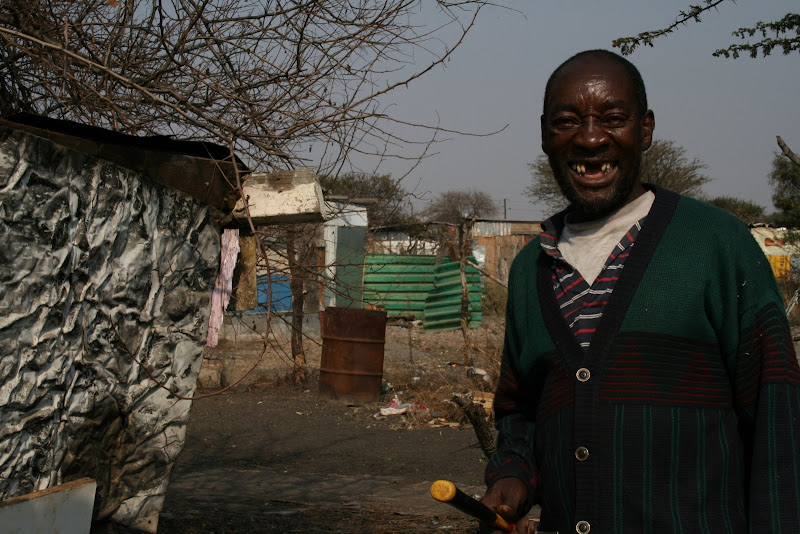
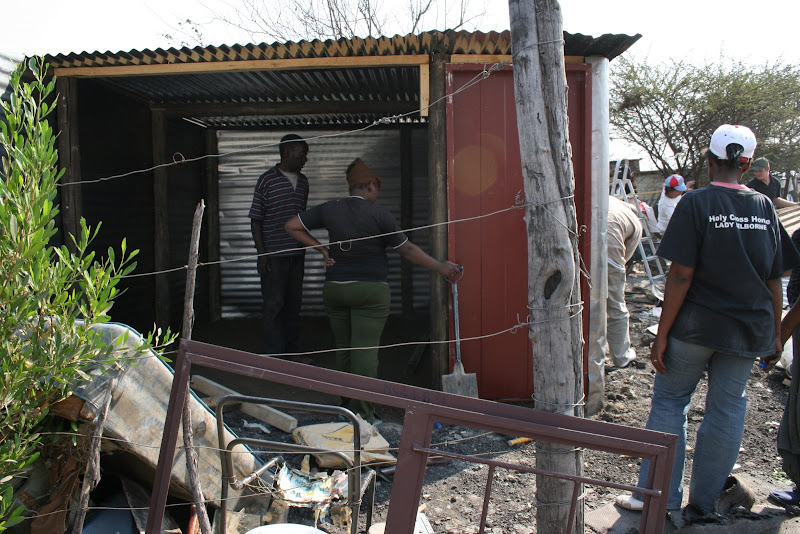
our two studies, bloom & the misfit toys, are joining together to build a house for a family outside Johannesburg with my friend sarah (maxie).
here are some fotos of the work maxie has done before. it's modest work, but a massive help for a family in tremendous need. each house costs $750 USD, so between bloom and the misfits we can afford it this month.
anyway - it kills me sometimes to think about how god has remarkably blessed us here in jackson...and how little we appreciate it...and how little with do with it.
taking a small amount of money from a couple dozen people and building a home like this one hardly counts as a major strike against inequity...but it's a start.
a start.
and, perhaps, for most of us a start is all that is required for us to begin living differently.






our two studies, bloom & the misfit toys, are joining together to build a house for a family outside Johannesburg with my friend sarah (maxie).
here are some fotos of the work maxie has done before. it's modest work, but a massive help for a family in tremendous need. each house costs $750 USD, so between bloom and the misfits we can afford it this month.
anyway - it kills me sometimes to think about how god has remarkably blessed us here in jackson...and how little we appreciate it...and how little with do with it.
taking a small amount of money from a couple dozen people and building a home like this one hardly counts as a major strike against inequity...but it's a start.
a start.
and, perhaps, for most of us a start is all that is required for us to begin living differently.
oops...props to pierre
we've used 2 phrases in this series and the teaching atlas that originate with my friend pierre in pretoria.
1. "move the fire in your pants to your heart"
2. "why don't you sleep with your wife for a change?"
i'd meant to make note of that in the atlas, but realize now that i didn't.
sorry, pierre - props to you
D
1. "move the fire in your pants to your heart"
2. "why don't you sleep with your wife for a change?"
i'd meant to make note of that in the atlas, but realize now that i didn't.
sorry, pierre - props to you
D
Sunday, November 02, 2008
Friday, October 31, 2008
today's activities: the carpet bomb of love
to promote "eat your heart out" at the winds, mexican j and i are going to be posting street signs in a variety of parking lots this morning.
look for these around jackson at: richmond agency, culligan water, big b's coffee, arrowswift, drake waters (cpa), and a few other spots tbd.
here's a sneak peak at the signs:


Thursday, October 30, 2008
the afterglow of our sexual acrobatics (excerpt from eat your heart out)
Our Sexuality is the portal of union and communion in this world with God, with others, with our true selves as image-bearers of God, and with the world.
Because that’s what we’re seeking: a way to be whole, to be un-separate, to find ourselves.
Of course, there are many distractions along the way – especially concerning our sexuality.
Many of us, for example, try to find complete wholeness through sex. But this is an illusion. Sex itself, having sex with another person, is not able to supply what we need.
No one ever believes this, though; we all seem pathologically incapable of grasping the fact that no orgasm is good enough, big enough, quick (or slow) enough, or repeated often enough to cure the sense of isolation we feel.
As soon as it’s over, we feel alone again, unless we are Loved.
But – again – no one believes this.
Sex is so much fun, it’s easy to put off the bothersome tidbit of loneliness we feel in the afterglow of our acrobatics. But the more we live the more we require to stave off that feeling. We have become a culture of sex addicts – always needing another quick fix – in order to just make it through another day.
sex on fire (some bullets + illustrations prepping for sunday)
We are made in God’s image, imprinted with His spark inside of us.
We are separated, sex-ed, and cut off.
 There is something inside of us which longs for wholeness. That something is the Divine Spark. We want to be wholly with God, we want to be whole people.
The desire for wholeness with God is our spirituality.
The desire for wholeness as a person is our sexuality.
That Fire inside of us is the drive towards wholeness, whether spiritual or sexual.
Wholeness occurs through covenant.
The covenant between man and woman is marked by sex.
Wholeness happens through covenant marked by sex.
We want to be whole so we are driven to have sex; however, in the absence of covenant, sex doesn’t make us whole it commodifies us.
 Sex must be exclusive and perpetual to be covenantal.
Sexual wholeness comes through exclusivity and perpetuity before God.
It is God who makes us whole sexually as author of the Covenant.
It is God who makes us whole spiritually as author of our humanity.

The Fire inside of us is the drive for wholeness, which can only be experienced through complete union and communion with God – whether sexual or spiritual or, most accurately, both.
 eatyourheart.info
We are separated, sex-ed, and cut off.
 There is something inside of us which longs for wholeness. That something is the Divine Spark. We want to be wholly with God, we want to be whole people.
The desire for wholeness with God is our spirituality.
The desire for wholeness as a person is our sexuality.
That Fire inside of us is the drive towards wholeness, whether spiritual or sexual.
Wholeness occurs through covenant.
The covenant between man and woman is marked by sex.
Wholeness happens through covenant marked by sex.
We want to be whole so we are driven to have sex; however, in the absence of covenant, sex doesn’t make us whole it commodifies us.
 Sex must be exclusive and perpetual to be covenantal.
Sexual wholeness comes through exclusivity and perpetuity before God.
It is God who makes us whole sexually as author of the Covenant.
It is God who makes us whole spiritually as author of our humanity.
The Fire inside of us is the drive for wholeness, which can only be experienced through complete union and communion with God – whether sexual or spiritual or, most accurately, both.
 eatyourheart.info
there is no such thing as a christian nation
when i was a little boy a great tragedy overcame canada: we were no longer, officially, a christian nation.
pollsters had realized that less than 51% of canadians professed to be christians, and so our "status" had changed forever.
this was something that was lamented in every church, christian school, youth rally, pastors gathering, etc. from then on (and continues today, albeit in a less "raw" sense).
but - here's the thing: i'm not sure canada was any different when i was 28 than when i was 8 or 18. the cultural issues were largely the same, the sense of dislocation felt by christians was largely the same, and the irrelevance of the church was still a big issue.
thing is, i don't think canada was ever christian
statistically, even when we were 75% christian, most of that was a cultural version of french catholicism practiced predominantly in quebec and among other francophones.
that's not to say that catholics aren't christians, just that most francophones consider themselves catholic much in the same way that midwesterners consider themselves christian even when neither group has paid any attention to jesus, the movement of the spirit, the mission of god, prayer, daily investment in the scriptures, etc.
their christianity is cultural, like a civil religion
if the olive garden is italian, these people are christians
if vanilla ice is rap, these people are christians
if the detroit lions are a pro football team, these people are christians
so...to recap...i don't think that the label of "christian nation" ever truthfully applied to the beautiful, honorable, greately missed, great white north.
but neither do i think it applies to the united states of america.
and neither do i think it rightly applies to any nation on the planet...ever.
of course, i make these claims for entirely different reasons.
see, i think that the idea that a nation is christian based on how many christians live there is entirely flawed. even if canada were 100% populated by christians, you could never call canada christian.
everything written about nations in scripture refers specifically to the nation of israel. so, when scripture talks about a nation being saved it's referring to the covenant people of god coming clean before god and making themselves right with god.
it's not talking about canada, america, mexico, uruguay, etc.
furthermore, in the second testament we're made to understand that christians are a nation unto themselves - meaning, christians are the people (read, nation) of God regardless of where they live.
you and i live in the same "christian nation" as our christian brothers are sisters in india. we are all part of the city of god. we all live as the people of god. and our "of-god-ness" has nothing to do with national or political lines on a map.
there are no christian nations because the real christian nation is comprised of those who follow jesus, regardless of wherever they live.
this is a difficult concept to grasp - i get that - and by talking about it i run the risk of being dismissed as abstract, obscure, or idealistic.
but the apostle paul himself refers to this as a "great mystery" in ephesians.
because it is so hard to grasp.
there is no such thing as a christian country. our countries are not good because they are christian.
our countries are good only to the degree that our policies and laws, practices and agreements, bring life to the world...but that doesn't just happen because the people who make those policies claim to be christians.
now, a couple closing caveats before anyone goes weird on me:
1. nationlism is still ok - love your country, serve your country, support the leadership of your country, but don't confuse loving your country with loving christ, and never think the former is somehow equal or (god forbid) more significant than the latter.
2. believing for your country to be saved is still ok - we can mine the scriptures for all kinds of hope and promise about canada, or the usa, being healed and made whole; about violence diminishing and cities being rebuilt and children being looked after. but don't confuse this with the notion that we are a christian nation and everything we do is in service to God because we've won this label.
3. believing that your country should be ethical is still ok - we should still demand that our governments make ethical decisions (and hold them accountable when they do not). we should still oppose evil, as a nation, wherever it is found through political, economic, and - yes - sometimes military intervention.
so...what am i really saying?
1. the church has to retain its right to criticize the government. that is the role of the prophet in scripture: to keep leaders honest before god. too often our churches have gotten political, and then there's no one left being spiritual. our role is to uphold ourselves, our world, and our people before god and demand that our politicians do the same to whatever degree they are able.
2. the state + its bureaucracy are soulless, meaning they are neither good nor evil. our goodness is determined by our actions. do we heal or harm? do we cultivate life or end it? does our intervention preserve justice or compromise it? we must insist on adjudicating our nation this way, rather than simply assuming that what we do is good because of who we are; or, as has become much more popular lately, assuming that whatever we do is bad because we think our current administration is evil somehow.
3. the people of god have a responsibility to live differently in this world. we often abdicate our moral responsibility to the state and then blame them for our own lack of courage. if you want to be a genuine follower of jesus christ then live differently. don't wait for america to become a christian nation in deed as well as in name; you should begin living now as a follower of jesus in deed and in name, and when that crosses over with your duty to your country (as it must on nov.4), you should spend deep time in prayer seeking the counsel of God and the movement of the spirit and vote with your conscience.
anyway, i write all of this out of concern for christians. many of us have swallowed some bad mojo about what it means to be a christian come election time.
many of us think that christians should all be republican.
many of us, an increasing number, have found that republicans don't really feel all that christian and so we're excited (almost unthinkingly) about being democrats.
but being a christian has nothing to do with whether you land as a republican or a democrat. neither party is the party jesus would support.
neither party is godly to its core.
every choice is a choice made despite our misgivings and in spite of our disappointment.
every christian is a republican with misgivings.
every christian is a democrat with misgivings.
it's not the party that makes us christians.
it's the misgivings and what we do with them that make us christians.
Ephesians 2.11-22
Therefore, remember that formerly you who are Gentiles by birth and called "uncircumcised" by those who call themselves "the circumcision" (that done in the body by the hands of men)— remember that at that time you were separate from Christ, excluded from citizenship in Israel and foreigners to the covenants of the promise, without hope and without God in the world. But now in Christ Jesus you who once were far away have been brought near through the blood of Christ.
For he himself is our peace, who has made the two one and has destroyed the barrier, the dividing wall of hostility, by abolishing in his flesh the law with its commandments and regulations. His purpose was to create in himself one new man out of the two, thus making peace, and in this one body to reconcile both of them to God through the cross, by which he put to death their hostility. He came and preached peace to you who were far away and peace to those who were near. For through him we both have access to the Father by one Spirit.
Consequently, you are no longer foreigners and aliens, but fellow citizens with God's people and members of God's household, built on the foundation of the apostles and prophets, with Christ Jesus himself as the chief cornerstone. In him the whole building is joined together and rises to become a holy temple in the Lord. And in him you too are being built together to become a dwelling in which God lives by his Spirit.
Wednesday, October 29, 2008

excerpt from the blue parakeet (scot mcknight)
THE STORY
God chose to give us a collection of books, what I call wiki-stories of the Story, and together these books form into God’s story with us and God’s story for us. Acts 7 is a good example of how to read the Bible as Story even though Stephen’s speech in Acts 7 is only one wiki-story of the Story. Again, each author in the Bible is a wiki-storyteller and each book is then a wiki-story, one story in the ongoing development of the big story. These are the major elements of that story:
1. God and creation
2. Adam and Eve as Eikons who crack the Eikon
3. God’s covenant community, where humans are restored to God, self, others, and the world
4. Jesus Christ, who is the Story and in whose story we are to live
5. the church as Jesus’ covenant
6. the consummation, when all the designs of our Creator God will finally be realized forever and ever
What we discover in reading the Bible is that each telling of the Story, each wiki-story, was a Spirit-inspired telling of the Story in each person’ day in each person’s way. God spoke through Moses in Moses’ ways for Moses’ days, through David in David’s ways for David’s days, through Jesus sin Jesus’ ways for Jesus’ days, and through John in John’s ways for John’s days. God always speaks a “contemporary” word. The genius of the Bible is the continuity of the Story as each generation learns to speak it afresh in its days and in its ways.
Furthermore, each wiki-storyteller, each author in the Bible, tells a story that will lead us to the person of the Story: Jesus Christ. As Moses and Isaiah look forward to that person, so Paul and Peter and Hebrews look back to that person. Jesus Christ, then is the goal and the center of each wiki-story.
This leads me to a major strategy in reading the Bible. Every author in the Bible was divinely directed through God’s Spirit to tell a true story of the one Story. This means that your task in reading the Bible is to “map” the elements of the Story in each wiki-story. If we keep our eyes on the six elements of the Story as outlined above, we will have all we need for reading the Bible. These six elements govern the story of the Bible and each book focuses on one or more of these elements.
facebook is a graveyard
this is why facebook depresses me to no end.
i go there to mourn my dead relationships
while i'm there i exchange brief quips with people i wish i saw more but know i won't;
i spend my time ignoring those who try and chat me up at the strangely-innapropriate-yet-ever-present-funeral-wake/bbq;
i view pictures of people i used to know, like ornaments around a coffin at a funeral, and lament the fact that i didn't know them like i wish i would have when i had the chance.
i'd never go to facebook again, except for how proud i am that my mom knows how to use it.
Tuesday, October 28, 2008
BOOK LIST FOR SEX SERIES
1. Images of Atonement, Message 7, Dave McDonald
2. Real Sex, Lauren F. Winner
3. The Four Loves, C. S. Lewis
4. Soul Cravings, Erwin Raphael McManus
5. A Woman’s Place, C. S. Cowles
6. Death by Love, Mark Driscoll and Gerry Breshears
7. Fed on Lies About Love, Message 1, Dave McDonald
8. Liquid Love, Zygmunt Bauman
9. Marriage, A History from Obedience to Intimacy, Stephanie Coontz
10. Searching Issues, Nicky Gumbel
11. Sex God, Rob Bell
12. Slaves, Women, and Homosexuality, William J. Webb
13. The Three Hardest Words, Leonard Sweet
14. Organic Unity, Message 6, Dave McDonald
15. Paul for Everyone, Tom Wright
16. Project Love, Andrew Marin
17. Three Philosophies of Life, Peter Kreeft
18. Forgotten Among the Lilies, Ronald Rolheiser
19. Life is High School, Ben Redmond
20. The Five Love Languages, Gary Chapman
21. The Holy Longing, Ronald Rolheiser
22. Mating in Captivity, Esther Perel
23. Original Blessing, Matthew Fox
24. Why Guys Need God, Mike Erre
25. Simply Christian, N. T. Wright
26. PowerPoint sources
27. Leadership, Currents
SEXY TIME (an introduction to "eat your heart out")
SEXY TIME
In 1969 the world was shocked at the first appearance of stark, sexual imagery used on network T.V. This footage featured a man and a woman in bed together for the first time on screen.
That deliciously seductive show? The Brady Bunch.
The Brady Bunch was the first show on television depicting a husband and wife sharing the same bed, and even showing them in bed together – albeit clothed in modest pajamas. Prior to this, shows had either neglected to depict the bedroom altogether or chosen to show husbands and wives sleeping in separate beds a la Fred and Wilma Flintstone.
We’ve come a long way, and – wow – things have certainly loosened up.
Over the course of this last week (October 2008), watching “normal” TV, I have seen images of startling sexuality (meaning, much more graphic than the Brady Bunch) on the following shows:
• the X-files (syndication)
• Lost
• Fringe
• Pushing Daisies
• Battlestar Gallactica (directed by Ron Moore, 2004 - )
• Firefly
• CSI Miami
• the Office
• Chuck
• Terminator: the Sarah Connor Chronicles
Now, you might read that list and think that it’s really just a matter of choice. After all, of course you’re going to see sex on a show called “Dirty Sexy Money” or “Sex and the City” or “the ‘L’ Word.”
But that’s precisely my point.
We live in a day and age where such shows are not only permitted on network TV, but they consistently top the ratings.
These are the most popular shows on TV (barring reality television…which brands its own kind of sexual cavalcade).
Sex is everywhere; and, because of that, the Church needs to do a better job of framing sexuality in the right way.
After all, sex isn’t dirty, or clandestine, or taboo.
Sex is good…great even! And it was created by God for us to enjoy within a marriage between a man and a woman.
So this Teaching Atlas is a foray into the wonderful, exciting, stimulating and energetic world of kinetic sexuality and spiritual submission to God.
Those two things do go together, by the way…more on that later.
A couple caveats, first though:
1. This isn’t a how-to manual.
There will be no diagrams, illustrations, or “steps” you can follow. This is not the Christian kama sutra, nor is it a guide to bedroom trapeze. This is an investigation into the sacramental nature of sex.
2. This isn’t always going to be comfortable.
Talking about sex is awkward. In my case, Carmel and I are very private about our own sex life; so, at times, I may be sweating more than you will be while reading this. That’s fine. This is still something we need to address, even if it feels weird. But be careful how much you expose your children to; then again, if they’re in elementary school, chances are they know more than they should anyway, so exposing them to straight talk from a biblical perspective on human sexuality may actually be a good thing…but still, exercise discernment with your kids.
3. This isn’t all about intercourse.
In fact, most of what this Teaching Atlas will cover is about what sex IS when properly understood, not how to HAVE better sex. We believe that sex has been so distorted by our media and our culture, that it remains the task of the Church to straighten those distortions out…which is largely an issue of understanding, not a technical issue.
Now, with all that behind us, here is a brief preview of what we’ll cover in the following chapters.
Chapter one will cover the idea of gender-as-separation and sex-as-wholeness. We’ll explore what it means to be erotic, meaning full of eros (passion), and talk about a holistic chastity. Chastity, here, refers to enjoying everything fully in its appropriate context.
Chapter two will look at all the different ways in which we love. We’ll explore those loves as healthy loves, and also caution ourselves against distorted versions of those loves.
Chapter three will be a collection of all the issues I have no desire to address because of their controversial or graphic nature, chief among these being homosexuality. I encourage everyone to this chapter closely, and not to assume they know what I will say or what I will emphasize – though it is fair to note that I am a conservative pastor, and that obviously frames my outlook on these issues.
Chapter four will talk, finally, about sacred sex and the holiness of sexual covenant. We’ll explore the biblical promise of marriage and the formation of a household. Additionally, we’ll be talking through “things we wish we’d known” before getting into our married lives.
Some final notes:
• First, let’s all begin by acknowledging that we are – each of us – deeply flawed and wounded by our distortions about sexuality. Beginning here, it is easy to understand that scripture may have something to teach us about being whole.
• Second, perhaps more than anything else, this Teaching Atlas is about how to live differently from here on out. Many of us have painful memories and mistakes in our sexual past, and the good news is that we can move past these things and into a new future. Jesus promises us new life, and that new life can help us forget, move past, and make right our previous errors.
• Finally, let us all be aware that – even if we feel fine about sex and even perceive it as something worth joking about – many of those who will journey with us in this life are decidedly NOT fine. As such, we must understand that it is not okay for us to joke about them, their sexual errors, their sexual struggles, or make light of their pain.
At the end of each chapter you will find a series of questions designed to help your personalize the meaning of each chapter. Those questions are best answered in a group, so you may find one of our Westwinds satellites helpful. For more information on satellites, contact becky.veydt@westwinds.org or call the church office at 517.750.1111.
theosis (christianity today article)
christianity today just did an article on theosis, which you can read here.
my friend matt just told me about it, and i'm pretty excited because much of what we've been jiving on at the winds lately is simply a re-formatting of this ancient doctrine.
my friend matt just told me about it, and i'm pretty excited because much of what we've been jiving on at the winds lately is simply a re-formatting of this ancient doctrine.
in the beginning...god danced through existence
(from a series used in fusion)
In the beginning…
God danced through existence in the solitude of Threeness
The tune roared through All
Singing space and keeping time
Until there were angels and heavenly creatures marked onto the score
And the dance got a little bigger.
The universe shouted for joy
And the stars jeted and tumbled
Pieces falling and collecting
Into planets
Into orbits
Into mystery
And in to life.
The dance was joy
And peace and hope
It was holiness and romance
And all who were in the dance were One.
From the farthest reaches of space
You and I woke up to the sound of the drums.
You tapped your toes and I cleared my throat
And we began to dance in our room.
Our invitation came right away
And we accepted.
You dressed up, but I stayed cas’
And we joined in the spinning circles of interplanetary majesty and salvation.
Now, in the dance, we’re looking out at the whole
And we’re texting our friends saying
Come dance, come dance
It’s good
It’s all good
The dance just keeps going on and on
And the pleasure never stops
It’s a party
And a ball
And a prom
And a wedding
And a feast
And it’s never gonna end.
Monday, October 27, 2008
in the beginning...the universe was created in a big, hot bang
(from a series of creation narratives used in fusion)
In the beginning…
God authored the universe in a big, hot bang.
The universe expanded from an extremely dense and hot state,
and it continues to expand today,
carrying galaxies with it like raisins in a rising loaf of bread.
Yup…it all started 16 billion years ago +/- 2 billion years.
For the first million years after the Big Bang, the universe expanded, the temperature dropped, and nuclei and atoms began to form.
Matter began to come together and make sweet galaxies under the force of gravity.
It started to rotate,
ultimately making spiral shaped galaxies like ours.
Within those galaxies hydrogen and helium were drawn together,
and got hot and heavy – literally, they got dense and warm.
Nuclear fusion commenced – lift off!
This process (still) provides the major source of fuel for stars.
Larger stars burn faster, smaller stars burn like cosmic crock pots.
As they begin to burn out, stars make heavier elements like carbon and oxygen.
Early in the universe (within the fist few hundred million years) such elements appeared only in the core of these dying stars,
but some of these stars blew up,
flinging heavier elements back into the gas in the galaxy.
Our sun is a second- or third-generation star,
a spatial step child
formed about 5 billion years ago by a great coming together of intergalactic debris.
Other debris, close by but not close enough to get sun-sucked,
became the planets in our solar system.
And, at first, our earth was a very inhospitable place.
The planet was constantly bludgeoned by giant asteroids and meteorites,
one of which actually tore the moon loose from the Earth – the first divorce.
Not surprisingly, rocks dating back 4 billion years or more show absolutely no evidence of life.
A piddling 150 million years later, the earth was crawling with life run amok
– a daystar daycare.
All of these steps in the formation of our solar system are now well described and unlikely to be revised on the basis of additional future information…
aka: we’re really, really sure this happened just like this.
Nearly all of the atoms in your body were once cooked in the nuclear furnace of an ancient supernova.
Yes, Paris – that is hot.
You are, truly, made of stardust.
Nothing grew on land until 400 million years ago,
at which point plants appeared on dry land, derived from aquatic life forms.
Beginning about 230 million years ago, dinosaurs dominated the earth.
They all died a sudden and catastrophic death about 65 million years ago,
at which an asteroid the size of Cuba fell crashed into Mexico,
creating what is now the Yucatan peninsula.
Fine crash-ash has been found around the world.
It ruined the environment and killed the dinosaurs.
This gave room for the mammals to take center stage.
That asteroid may have been the only possible way the dinosaurs could have become extinct and we could have come to power.
We probably wouldn't be here if that asteroid hadn’t slapped our neighbors to the South.
Bones of more than a dozen different man-like species have been discovered in Africa, with steadily increasing brain sizes.
The first proof of “modern” man showed up about 195,000 years ago.
Other men-folk appear to have encountered dead ends:
Neanderthals existed in Europe until 30,000 years ago,
and "hobbits," tiny people with small brains who lived in the island of Flores in Indonesia survived until 13,000 years ago.
No serious biologist today doubts the theory of evolution to explain the marvelous complexity and diversity of life.
Evolution, as a mechanism, can be and must be true.
But that says nothing about the nature of its author.
For those who believe in God, there are reasons now to be more in awe, not less.
Friday, October 24, 2008
help me to live differently (prayer for fusion, week 6: genesis)
GOD –
THIS WORLD IS FULL OF VIOLENCE AND I AM SPENT ON CONFLICT.
I AM TIRED OF FIGHTING,
I AM TIRED OF DEFENDING WHAT WE DO,
AND I AM TIRED OF BEING THE ONLY PERSON TO ASK:
IS THIS RIGHT?
IS THIS WHAT IT MEANS TO FOLLOW YOU?
I WANT TO LIVE BETTER.
I WANT TO SHADOW YOU IN WAYS THAT BRING HEALING.
I WANT TO MEND THE WORLD.
AND WELCOME YOU MORE FULLY INTO IT.
PLEASE HELP ME TO FIGHT CLEAN,
TO FIGHT FAIR,
AND TO FIGHT WITH THE RIGHT WEAPONS.
I WANT TO BE A LOVER,
NOT A PUGILIST.
I CONFESS MY GREAT FAILURE IN THIS AREA
AND I CONFESS MY ANGER, MY RESENTMENT, AND MY GRIEF.
TAKE THEM FROM ME.
GIVE ME SOMETHING DIFFERENT IN RETURN.
GIVE ME EYES THAT SEE WHAT YOU ARE DOING IN THIS WORLD.
GIVE ME HANDS THAT HELP.
GIVE ME LIPS THAT PROFFER DEVOTION,
THAT READILY SAY TO YOU: WHEREVER YOU GO, I WILL FOLLOW.
WHEREVER YOU NEED ANYONE
PLEASE KNOW
THAT I AM HERE
AND YOU
CAN SEND ME.
AMEN.
free sex atlas
in case you're curious about what we'll be teaching concerning sexuality, we've made the teaching atlas available in advance as a downloadable .pdf file.
as always, let me suggest that one of the best ways you can actually "get" something from the teaching in fusion (or in any other sermon, lecture, oratory, speech, etc) is to prep a little in advance, and then review a little later on.
trust me - that'll be a whole lot easier with material like this :)
you can download it for free here
(you can also download other atlas pdfs for free here )
great article from guns 'n roses bass player
duff mckegan was a god in 8th grade. i loved gnr, i loved everything mullet-ish and tight-pants-ed.
but everyone grow up and everyone changes; so, duff is now a dad and he is terrified of his daughters growing up in a world like ours, saturated with sex.
you can check it out here
but everyone grow up and everyone changes; so, duff is now a dad and he is terrified of his daughters growing up in a world like ours, saturated with sex.
you can check it out here
Thursday, October 23, 2008
eatyourheart.info
just finished the flash site for the next series at the winds: eatyourheart.info
it's simple, pretty, and easy to navigate.
my hope is that people will use the site as a conversation piece about sexuality and spirituality. i want our people to acknowledge that there is a spiritual dimension to sex, that sex is good and god-authored, and that our sexual identity in this world is deeply compromised.
i also want others to come to grips with the stark, honest, and bold teaching at the winds about sexuality. i want them to know this won't be a series about hugging your mom and chastely kissing your husband.
it's about sex.
and sex is spiritual.
and sex is distorted.
and part of our mandate before god in this world is to heal distortions.
and we must be part of putting sex back together again.
so, yeah: eatyourheart.info
Subscribe to:
Posts (Atom)


 Posts


